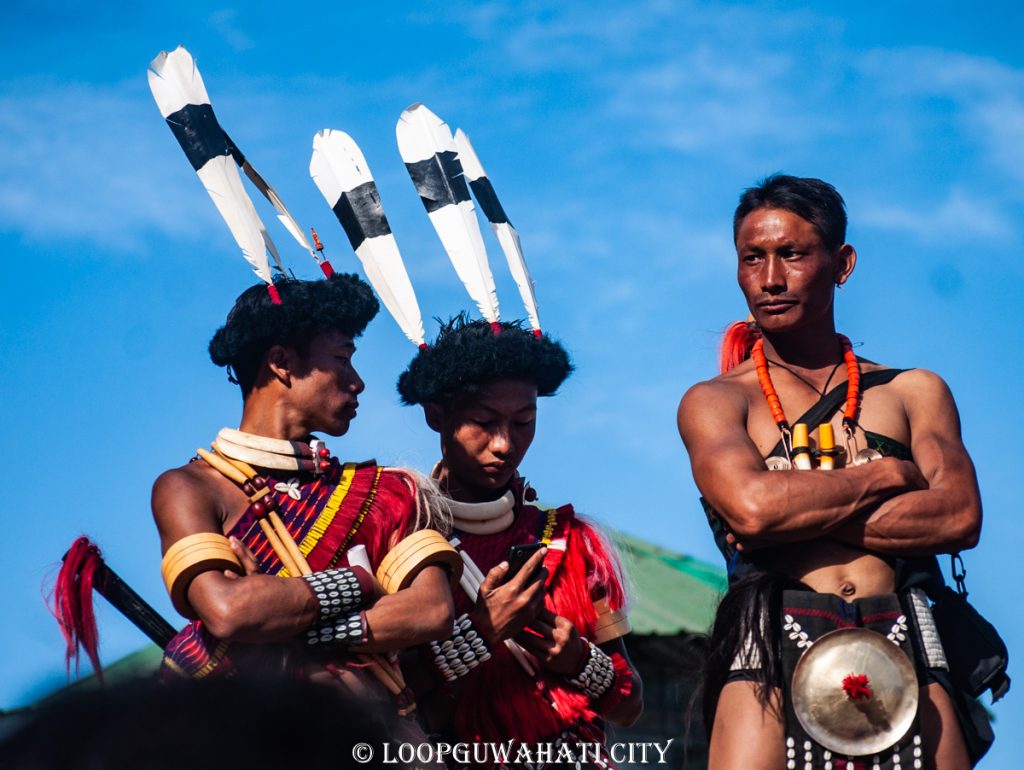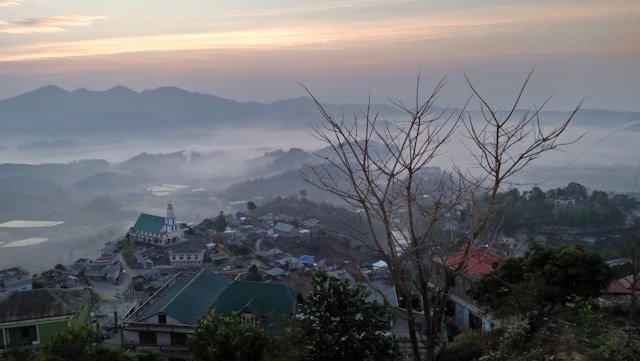
Arunachal Pradesh Tourism is still sort of an enigma. Couple of places in the state have become really famous in the recent years but still a huge number of potentially blockbuster spots that remain hidden due to information gap and lack of infrastucture.
Arunachal Pradesh was originally known as North Easter Frontier Agency (NEFA) by the British. As the name suggests, the region was always a remote and not particularly accessible area without any clear demarcation or identity. The British kept it as it is, a buffer between Tibet and Brahmaputra Valley. Finally in the 1960s the region was made a full fledged state and given the name Arunachal Pradesh, the land of sunrise, as the easternmost parts of the state are also the easternmost parts of India, that receive the first rays of the sun everyday.
Even now, Arunachal remains the remotest, most pristine, and most mysterious of all the states in India. The remoteness used to keep the tourists away at one point of time but the more adventurous millennial travellers are getting attracted by the same and lining up to experience it’s eccentric cultures, unadulterated natural beauty, and adrenaline pumping adventures.
Arunachal covers a vast area. In fact, it is the largest of all NE states. However, most of the area is covered by dense jungles and inaccessible mountains. As a result, it is sparsely populated with very few big towns. Although population is small, it is incredibly varied in terms of ethnicities and culture. There are dozens of tribes in the state, all having their own culture and language. Monpas, Adis, Galos, Nyishis, Apatanis, Membas, are only a few of the tribes that can be found here and most of them their own areas of influence within the state.
In general, Arunachal offers a heady mixture of Tibetan Buddhist areas such as Tawang and Mechuka, dense jungle experiences such as Namdapha and Pakke, interspersed with barely explored valleys, desolated treks, and eclectic cultural experiences offered by the followers of Donyi Polo, Arunachals own religion.
The availability of tourist infrastructure varies from place to place in Arunachal. Some places like Tawang and Ziro have been popular for a long time now a days these areas have many hotels and homestays for tourists. Some other locations such as Mechuka are being developed as new tourist destinations and they also have good facilities now. However, most other places here remain remote and in many places the only option remain the government rest houses.
Understanding Arunachal
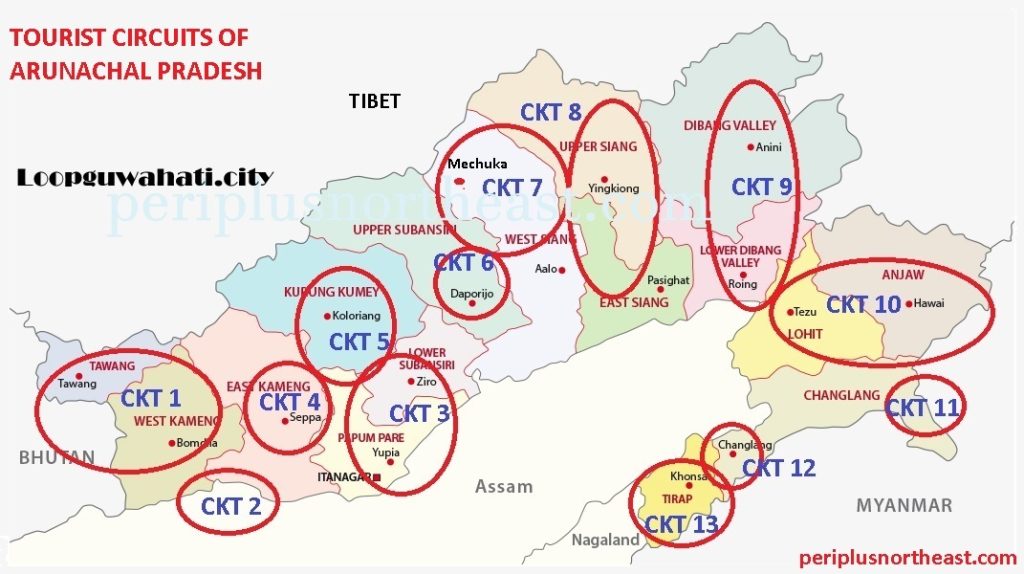
Arunachal Pradesh is the largest state in the Northeast. However, most of the region is covered by dense forests and high mountains. Inhabited areas are scattered all over, mostly around river valleys. The Arunachal Tourism department has defined 12 different tourist circuits of Arunachal for exploration and it is better to understand the state in that manner. One additional circuit has been added on behalf of Loop Guwahati as it is an up and coming region.
It should be noted that due to remoteness and difficult roads, it takes a lot of time to traverse these routes and generally people explore one or two circuits at a time because covering the whole state at one go will take months. But rest assured that all these circuits can offer you some of the most unique travel experiences you will ever have and that is the reason for taking up such arduous journeys.
How to Reach Arunachal?
By Road
Arunachal shares a very long border with Assam and so there are multiple entry points along the stretch. Your entry point will depend on your destination. If you are going to Tawang and Ziro, you need to go through Tezpur, for Kibithu or Namdapha, you need to go through Dibrugarh or Tinsukia, and for Mechuka it makes sense to enter through Dhemaji district.
Major overland entry points into Arunachal Pradesh from Assam, the circuits they open into, and the nearest major Assam city are:
Western gateways
- Bhalukpong (West Kameng border)
- Balemu check‑post (West Kameng border)
Central gateways
- Banderdewa / Gohpur–Banderdewa (Itanagar gate)
- Hollongi / Itanagar (near new Greenfield airport)
Siang–Subansiri belt gateways
- Ruksin / Pasighat gate (near Silapathar–Jonai)
- Kimin / Potin side (for Ziro)
Eastern Arunachal gateways
- Shantipur / Dhola–Sadiya–Shantipur (Roing gate, Lower Dibang)
- Dirak / Namsai gate (Namsai–Tezu side)
- Digaru / Tezu side (Lohit)
- Namsai–Miao / Namdapha side (Changlang)
Southern Tirap–Longding gateways
- Khonsa / Tirap entry (via Assam’s Sibsagar–Duliajan belt)
If you want, a compact markdown table can be created for direct use in an article.
By Train
Arunachal does not have much of train connectivity. The only real railway line reaches Naharlagun, around 20 KMs from capital Itanagar. Other than that, you can reach Murkongselek in Assam, which is very near to Pasighat, or Tinsukia, which is a good point to approach Kibithu, Roing, Namdapha, or Pangsau Pass.
By Air
Arunachal does have a few airports but most of them are either not functional or have very limited connectivity. Places like Itanagar, Ziro, Tezu, and Pasighat have airports but only Pasighat has started commercial flights recently. However, Pawan Hans runs helicopter services connecting Guwahati to Itanagar, Tawang, and Anini although it depends on a lot on the weather.
People and Culture of Arunachal
Arunachal has several dozen different tribes with their own respective culture and language. It is such a diverse place in terms of ethnic and cultural diversity that one lifetime will not be enough to explore them fully. Apatanis, Adis, Galos, Tagins, Mishmis, Monpas, Tangss, Noktes, Membas, Sherdukpens, Nyishis, Lisus etc are only a few of those different ethnic groups.
Some of the tribes that live near the Tibetan Border, such as the Monpas and the Membas, are closely related to the Tibetans and follow Tibetan Buddhism. In fact, Tawang, inhabited by the Monpas, is one of the most important centres for the Tibetans. Most other tribes follow ancient animist religions. In the recent decades, especially the Tani people such as the Apatanis, Nyishis, Galos, etc have developed Donyi Polo, a locally organized religion which draws from the ancient traditions and worships the nature (Donyi= Sun, Polo=Moon), in order to prevent the locals from converting to external religions.
Generally, different tribes inhabit different areas and so you will have a different experience depending on the areas you visit.
ILP and PAP for Arunachal
Every tourist needs to get permits before entering Arunachal. Indian tourists need Inner Line Permit (ILP), while foreign tourists need Protected Area Permits (PAP). It can be obtained from various offices located all over India. Do note that foreign tourists should be in groups of a minimum of two people to get permits.
Transportation & Accommodation within Arunachal
Internal transportation is not very easy in Arunachal. Hiring a vehicle for yourself is the most convenient way although it is more expensive. Bus services are rare and they cover very few places. Most places are generally connected by shared SUVs and MUVs which run daily at fixed times. This is why travelling on public transport is very difficult in Arunachal and you should collect enough information about the same before going out there.
Phone and Data Connectivity in Arunachal
Phone and data connectivity has vastly improved in recent years. At one point,
What to See in Arunachal?
The Arunachal Tourism has divided the entire state into 12 major circuits, for the sake of organization and convenience. Out of these, some circuits such as Tawang and Ziro are well known, while some others like Mechuka and Roing are up and coming destinations. Furthermore, there are circuits such as Koloriang and Tuting, which are visited by few and hardly any information is available about them. The following are the most popular.
Ziro: Not just a Music Festival
The Ziro Festival of Music has single-handedly brought Ziro to the forefront of tourism in Northeast India. Wildly successful and popular, this event takes place every September in the lush, open valleys of Ziro as scores of bands and musicians from all over India and abroad gather and take part in this musical extravaganza. However, it is not only limited to that. The Ziro Valley is a great example of co-existence of humans and nature, something that has been perfected by the Apatanis over centuries. The agricultural skills and ecological knowledge of the Apatanis is unparalleled and is visible in their management and conservation of limited natural resources, perfected over centuries of experimentation. Especially noticeable is their wet-rice cultivation on the plains where they also rear fishes on the same fields. They supplement the same with millets on the hilly slopes. Most of them also follow Donyi-Polo religion, which is completely unique and has no relation to major organized religions of the world. In short, it is a treasure trove for cultural and ecotourism.
Tawang: A Slice of Tibet
Tawang, bordering Tibet on the north-western corner of Arunachal Pradesh, is a major centre of Tibetan Buddhism and it has played an important role in their history. The fact that the Sixth Dalai Lama was born in Tawang in the 17th century, tells us of the importance of the town in the Tibetan world. The 400 year old Tawang Monastery atop the hill dominates the landscape of Tawang and it is the second largest in the world after the one in Lhasa. You can go beyond Tawang to visit attractions such as Bum La, an old trading route connecting to Tibet, Sangetsar, a beautiful high altitude lake that is also known as Madhuri Lake after the Bollywood actress who once shot a film here, and several war memorials and shrines from the 1962 Indo-China war. The route leading to Tawang also has many other attractions. It passes through the likes of Tezpur, a historical town in Assam, as well as a picturesque towns in Arunachal such as Bhalukpong and Bomdila. You also pass through Dirang, a serene Buddhist town, which is the gateway to Sangti Valley, a secluded paradise covered with pristine forests and fruit orchards. More hardcore travellers can also consider some treks around the Gorichen Mountain.
Mechuka: The Next Hotspot
According to a lot of experts, Mechuka is the next tourist hotspot in Arunachal. After Tawang and Ziro, this area is likely to become the most sought after destination very soon. It is surprisingly well-developed in terms of tourism with a lot of homestays in that small town surrounded by snow-clad mountains. Mechuka is inhabited by the Memba people who follow Tibetan Buddhism. There is a new monastery in town and an ancient monastery a short hike away from the town. It snows here in the winters and a lot of tourists also visit this place to witness snowfall. Apart from enjoying the scenery, you can visit the local monastery and trek up to the hills surrounding the valley for a better view. For a more serious trekking experience, one can trek to a nearby high altitude lake, which takes around three days.
Namdapha: India’s own Amazon
Namdapha is a bio diversity hotspot and also a part of Project Tiger. Yet, it is not easy to spot animals here. The thick forest hides most of them and sighting large mammals is almost impossible. If you are lucky and the weather is good you may see some birds, monkeys and gibbons. Besides, general tourists are only allowed in the buffer zone and the very few people can reach the core area. This is truly a rainforest, with vegetation so thick that most parts of the jungle still remains impregnable. Many have compared this stretch to the great rainforests of the Amazon. Even a simple walk through those impregnable jungles will last a long time in your memory.
Pangsau Pass Winter Festival: A Date with Myanmar
This festival was conceptualized to develop this remote region in the Changlang district of Arunachal. It takes place every January and tourists as well as artists from the entire northeast take part in this extravaganza of music, dance, wine and food. Most of the vents take place in Nampong town, near Myanmar Border. Historically, this has been a trading town for people from both Arunachal and Myanmar. This also falls on the historic Stillwell Road, which was built with great difficulty during the WW II by the allied forces. Although it is not functional now, plans exist to develop a great Asian Highway through this area connecting India to Southeast Asia.
Bhalukpong and Seijosa: Of Tigers and Orchids
Bhalukpong is a small town on the Assam-Arunachal border, near the Pakke Tiger Reserve, which is a dense tropical forest that has been declared as a Project Tiger Reserve. Apart from tigers, it boasts of elephants, gaurs, sambars, barking deers, leopards, langurs, macaques, etc. It is also known for a huge diversity of birds and butterflies. Especially, the hornbills conservation program here has won a lot of praise. Also, Tipi is a small village just a few KMs ahead of Bhalukpong. It is known for the orchid Research Centre, which was establish to protect and promote the huge variety of beautiful orchids available in this region. You can see hundreds of different orchid species here and the nearby jungles have been declared as the “Sessa Orchid Sanctuary”, a vast area of fragrant wilderness where orchids bloom in nature. Apart from these, you can also go river rafting at Bhalukpong.
Arunachal Tourist
As mentioned before, Arunachal Tourism Department has divided the state into 12 circuits for tourism. This map shows their rough locations. As you can see from the map, Arunachal surrounds Assam from three sides and to reach any part of the hills in Arunachal, you have to go through Assam.